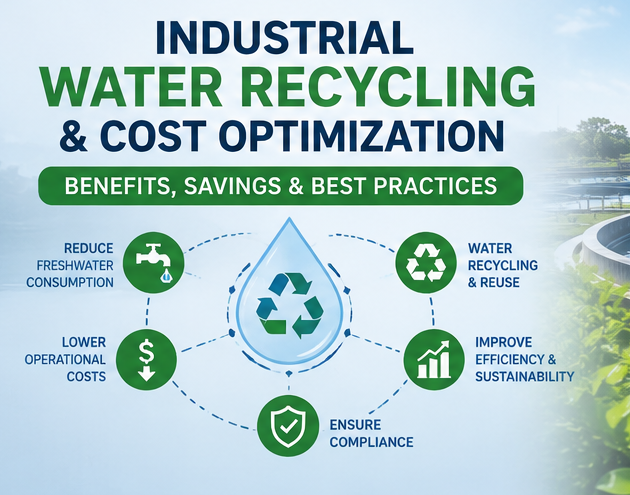
11. Enables Water Recycling and Reuse
Water recycling is one of the strongest opportunities for long-term cost reduction.
Instead of using freshwater once and then disposing of wastewater, industries can recover and reuse water.
A typical approach may look like:
Industrial Process → Wastewater → ETP → UF/RO → Recovered Water → Reuse
The actual treatment train depends on the wastewater characteristics and reuse requirement.
Financial Advantage
Water recycling can potentially reduce:
- Freshwater purchase
- Wastewater disposal
- Production-related water losses
It also improves the overall efficiency of the industrial water cycle.
12. Helps Reduce Sludge and Waste-Management Costs
Inefficient chemical treatment can generate excessive sludge.
More sludge means:
- More dewatering
- More storage
- More transportation
- Higher disposal costs
- Greater operational effort
Proper process optimization and appropriate treatment selection can help minimize unnecessary sludge generation while still achieving the required treatment performance.
13. Supports Regulatory Compliance and Avoids Potential Costs
Industrial facilities must comply with applicable environmental and water-management requirements.
Poor wastewater treatment can result in:
- Non-compliance
- Corrective actions
- Additional treatment requirements
- Production interruptions
- Financial penalties, where applicable
- Reputational damage
A properly designed and operated treatment system can help industries maintain consistent treated-water quality and reduce regulatory risk.
Compliance should therefore be considered part of long-term cost management, not merely an environmental obligation.
14. Improves Overall Production Efficiency
Water treatment does not operate independently from manufacturing.
Water quality can influence:
- Heat transfer
- Cleaning efficiency
- Equipment performance
- Product quality
- Production reliability
- Maintenance frequency
When the water supplied to each application meets its required quality, the complete process can operate more consistently.
This can translate into improved overall operational efficiency.
15. Supports Zero Liquid Discharge and High Water Recovery
Some industries need very high levels of water recovery because of water scarcity, site conditions, or applicable requirements.
In such cases, advanced treatment systems may be integrated into a Zero Liquid Discharge (ZLD) strategy.
A simplified treatment sequence may include:
ETP → Membrane Treatment → RO → Evaporation → Crystallization
The objective is to recover water for reuse and manage the remaining concentrated contaminants as solids.
Although ZLD systems can involve significant capital and energy requirements, they may provide strategic benefits where freshwater availability and liquid-discharge constraints are major concerns.
How to Calculate the Potential Savings?
Before investing in a water-treatment or recycling system, industries should conduct a total cost of ownership analysis.
A simple framework is:
Current Annual Water Cost
Freshwater Purchase + Water Handling + Wastewater Disposal
Current Treatment Cost
Chemicals + Energy + Maintenance + Consumables + Labour
Potential Savings
Freshwater Savings + Wastewater Disposal Savings + Energy Savings + Maintenance Savings + Avoided Downtime Costs
The actual financial benefit will vary from one industry to another.
Therefore, a detailed feasibility study should consider the site's actual water consumption, wastewater characteristics, treatment requirements, and operating costs.
Example: How Water Treatment Can Create Multiple Savings
Consider a manufacturing facility experiencing:
- High boiler scaling
- Frequent heat-exchanger cleaning
- High freshwater consumption
- Significant wastewater generation
- Frequent equipment maintenance
A comprehensive water-management strategy could include:
Raw Water Treatment → Process Water Treatment → Wastewater Treatment → Water Recovery → Reuse
This approach can potentially address several costs simultaneously:
Before Optimization
Freshwater → Production → Wastewater → Disposal
After Optimization
Freshwater → Treatment → Production → Wastewater → Treatment → Recovery → Reuse
The objective is to keep water within the industrial system for as long as practically possible.
Best Practices for Reducing Water-Related Operating Costs
1. Conduct a Complete Water Audit
Identify:
- Where water enters the facility
- Where it is consumed
- Where wastewater is generated
- Where water is lost
- Where reuse is possible
2. Analyze Water Quality
Treatment should be based on actual water chemistry rather than assumptions.
3. Match Water Quality to the Application
Not every process requires the same quality of water.
Avoid unnecessarily treating water to a higher quality than the application requires.
4. Monitor Treatment Performance
Track:
- Flow
- Pressure
- pH
- TDS
- Conductivity
- Chemical consumption
- Energy consumption
- Recovery rate
5. Maintain Equipment
Preventive maintenance helps avoid expensive breakdowns and performance losses.
6. Maximize Water Reuse
Identify opportunities to reuse treated water safely and economically.
7. Evaluate Lifecycle Cost
Do not compare treatment systems only on purchase price.
Consider:
Capital Cost + Operating Cost + Maintenance + Consumables + Energy + Replacement + Disposal
Choosing the Right Treatment Partner
The effectiveness of an industrial water-treatment system depends heavily on proper engineering and application-specific design.
A treatment partner should understand:
- Raw-water characteristics
- Industrial processes
- Required water quality
- Wastewater characteristics
- Water-reuse opportunities
- Energy requirements
- Chemical consumption
- Equipment maintenance
- Future expansion
A system designed around the actual process is more likely to provide reliable performance than a standard solution selected only by capacity.
How Enversys Greentek Solutions Can Support Industrial Water Management
At Enversys Greentek Solutions, water and wastewater treatment solutions can be developed around the specific requirements of industrial applications.
The objective is not simply to install treatment equipment, but to develop a solution that supports:
- Reliable water quality
- Efficient wastewater treatment
- Water recycling and reuse
- Reduced freshwater dependency
- Improved operational efficiency
- Sustainable water management
- Long-term cost optimization
Depending on the application, treatment strategies can incorporate conventional, membrane, electrochemical, and advanced wastewater-treatment technologies.
The right combination should always be determined through water analysis, process evaluation, treatment objectives, and lifecycle-cost assessment.
Conclusion
Industrial water treatment should not be viewed only as an environmental or regulatory requirement. When properly designed and operated, it can become a strategic tool for reducing operational costs.
By controlling scaling and corrosion, protecting equipment, improving heat-transfer efficiency, reducing freshwater consumption, enabling water recycling, optimizing chemical use, minimizing wastewater disposal, and reducing water-related downtime, effective treatment can deliver value across the entire manufacturing operation.
The key is to look at water as part of the complete industrial process, rather than treating water supply and wastewater disposal as separate activities.
A successful water-management strategy should answer three fundamental questions:
How much water are we using?
Where can we reduce consumption?
How much of the wastewater can we safely recover and reuse?
When these questions are addressed through proper engineering and process optimization, industries can move toward lower operating costs, improved resource efficiency, and more sustainable manufacturing.
Smarter Water Management. Lower Operating Costs. Sustainable Industry.
The right water-treatment strategy doesn't just clean water—it creates operational value.